
Authentication for the new era of conflict

Hold the line.

Bitcoin-anchored authentication.
Power projection for military networks.
No servers. No central authority.
It works when everything else has been destroyed.

See how it works ↓

The Problem

Every military network shares one fatal weakness.

Authentication decides who is allowed onto a network. Today, every system does this the same way — a trusted central server issues and verifies the credentials. Take down that server, and in a modern conflict it is the first target, and the entire network goes dark. Ships, aircraft, and coalition partners are locked out at the exact moment they need each other most.

Certificate authorities and identity providers are the first targets in a contested environment — not because they are difficult to attack, but because disabling them disables every node at once. Coalition partners cannot be admitted under fire. Forward-deployed platforms cannot re-authenticate after a communications blackout. The centralized model fails exactly when operational stakes are highest.

It gets worse at the edge. Forward units, submarines, and autonomous systems operate in denied, degraded, and disconnected conditions — no satellite link, no key server, no way to reach a central authority. Conventional zero trust fails precisely where the fight is hardest.

Single Point of Collapse

The central authority is the first thing an adversary destroys. When it falls, every node falls with it. This is a major weakness of servers and centralization.

Pre-Shared Keys Don't Scale to Coalitions

Bringing a new ally onto the network means exchanging cryptographic keys in advance. In a crisis, that process takes days.

It Breaks When Disconnected

The denied, degraded, disconnected environment of peer conflict is exactly where today's systems stop working.

The Solution

A network with no center to break.

HashDome removes the central server entirely. Trust no longer comes from one point that can be destroyed — it flows through a phalanx, where every authorized participant is vouched for by a sponsor who has put real value at stake.

Each node carries a Bitcoin-based identity. To join the network, it presents a sponsorship — a cryptographic guarantee from a sponsor who has proven, on the Bitcoin blockchain, that it holds significant value and stands behind this participant. To authenticate, the node proves real computational work, making any attempt to flood or spoof the network physically expensive.

Where conventional authentication relies on administrative permission — which an adversary can revoke by targeting a server — HashDome admission requires irreversible thermodynamic work. Forging an identity costs energy. Flooding the network costs capital. Neither can be faked, and both can be verified offline against a cached block header.

No central authority. No pre-shared keys. No connection required. The line holds.

Physics and stake are the gatekeepers — not a server that can be destroyed.

How It Works

Trust flows through the phalanx.

Three interlocking primitives replace the central authority. Each one is independently verifiable, each one imposes a real cost, and together they function with no server and no connectivity.

Bitcoin Identity

Every participant's identity is a Bitcoin keypair. There is no certificate authority to compromise and no password database to steal. The identity is self-sovereign and verified against the most attack-resistant network ever built.

Sponsorship & Stake

Sponsors — nations, commands, defense ministries — prove on-chain Bitcoin holdings and sign for the nodes they vouch for. A sponsor who acts in bad faith loses everything it vouched for, instantly, across the entire network. Skin in the game.

Works Offline

Using cached blockchain data, two nodes that have never met can verify each other in seconds with no internet, no servers, and nothing in common except their anchor to Bitcoin. It works when everything around it has gone dark.

Rocket launching into an orange hazy sky at dusk

Why Now

The doctrine has caught up with the technology.

In April 2026, the Commander of U.S. Indo-Pacific Command testified before the Senate Armed Services Committee that his command is running a live Bitcoin node and conducting operational tests to secure military networks using the Bitcoin protocol — not as a financial asset, but as a computer-science tool for resilience and deterrence.

The world's largest military command has validated the thesis. The mechanisms are proven. What is missing is the company that hardens them for the battlefield. That is HashDome.

FIRST

four-star command to validate Bitcoin for network defense

380,000

personnel across the largest U.S. unified command

32

allied nations sharing coalition networks

0

competitors building this for denied environments

Technology

Built on physics, not policy.

HashDome does not ask you to trust a vendor, a certificate authority, or a government key server. It asks you to trust mathematics.

The authentication mechanism is grounded in Bitcoin's proof-of-work: the only security primitive in existence that is enforced by the laws of thermodynamics. An attacker cannot fake it with software. Spoofing requires real energy expenditure at industrial scale. This is not a policy control that can be overridden — it is a physical constraint.

The sponsorship layer adds an economic dimension: sponsors put provable, on-chain Bitcoin holdings at stake. Bad-faith behavior is not merely penalized — it is immediately and irreversibly costly. Trust is not assumed. It is staked.

Trust-state commitments are co-signed by a threshold of t-of-n validators using Schnorr threshold signatures (FROST). No single validator can publish a fraudulent trust-state root. Compromise of fewer than t validators leaves the system intact.

// HashDome node authentication — simplified
hashdome.verify({
  node_pubkey:   "02a3f...7c91",
  sponsor_proof: "block_844921.utxo[14]",
  pow_nonce:     0x00000000ab7f3c,
  timestamp:     1746201600,
  offline_mode:  true
})
// → {
//      authenticated: true,
//      latency_ms:    47,
//      connection:    "air-gapped"
//    }

Applications

Where the line must hold.

The threat environment that HashDome is designed for spans every domain of modern conflict — from contested maritime corridors to severed cable infrastructure.
Military Networks

Joint task forces, maritime strike groups, and forward-deployed units operating in contested or comms-denied environments — authenticated with zero dependence on reachback.

Coalition Operations

Allied forces joining a network in hours, not days. No pre-shared keys. No trusted third party. Membership vouched for by the nation's command, staked on-chain.

Autonomous Systems

USVs, UUVs, and drone swarms that authenticate each other at the edge — no operator in the loop, no connection to base, no spoofable identity.

UAV & UUV Swarms

Each UAV or UUV operates as a credentialed node. Admission receipts bind each vehicle's identity to a recent Bitcoin block, preventing spoofed nodes from joining a swarm mid-mission. Policy constraints — geofences, altitude limits, rules of engagement — are recorded immutably alongside the admission record.

Critical Infrastructure

Power grids, communications backbones, and command nodes that must stay authenticated through a first strike, a jamming campaign, or a severed cable.

Strategic Context

Hash rate is now a contested geopolitical resource.

Five of nine falsifiable predictions from the 2023 Softwar thesis have been confirmed within three years: a U.S. Strategic Bitcoin Reserve, sovereign mining operations, record institutional inflows, and a documented narrative shift from speculative to strategic among the world's largest asset managers.

Nations that treat proof-of-work as infrastructure rather than speculation are building the authentication layer of the next conflict before it begins. The question is no longer whether Bitcoin's thermodynamic properties are militarily relevant. The question is who builds the operational layer first.

HashDome is that layer.

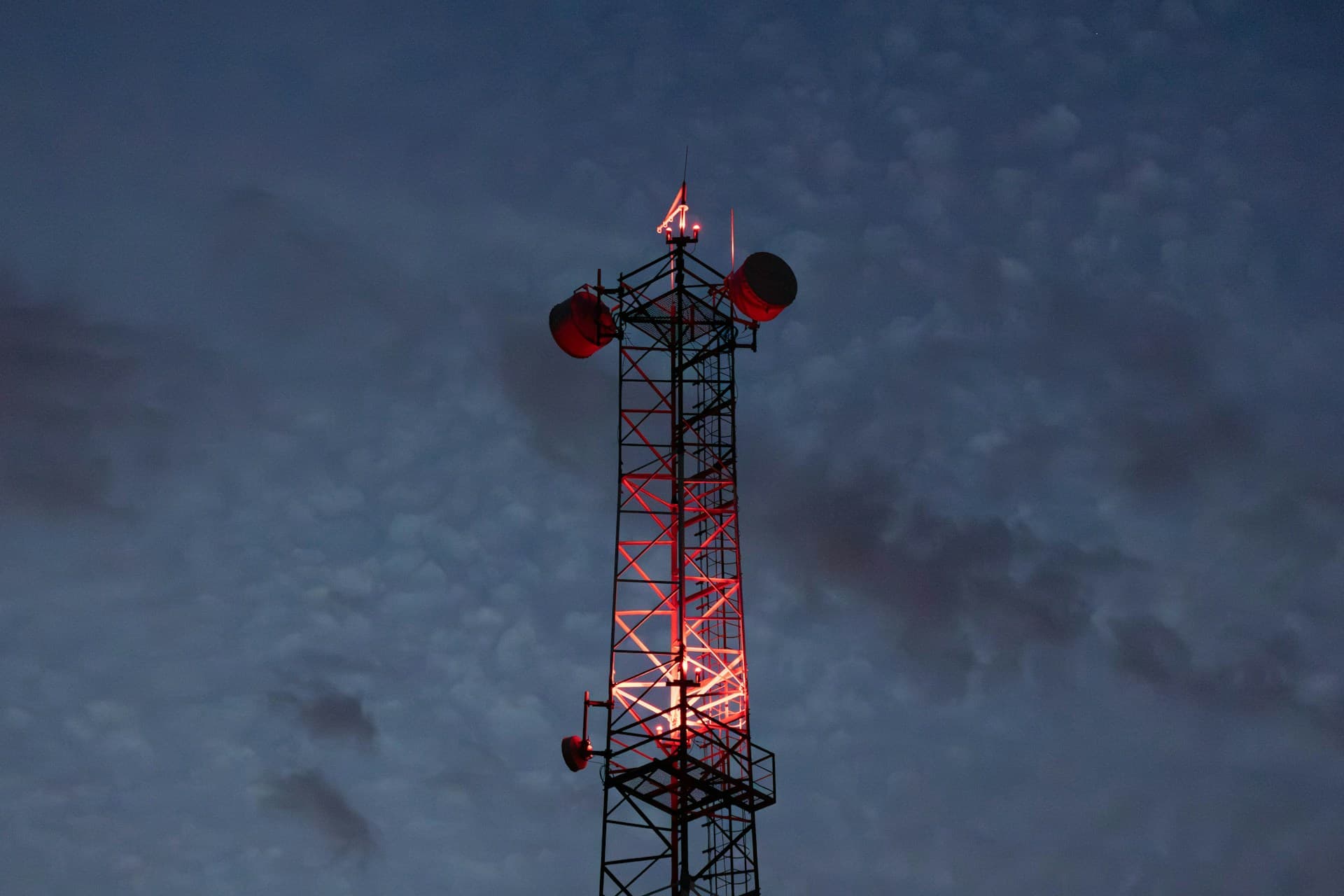
Red-lit communications tower against a dark sky

About

Built from the inside.

HashDome was created by a systems engineer with over twenty years operating inside frontline defense environments. The background spans submarine weapon systems engineering, board-level defense audits, large-scale C4ISR programs, maritime digital transformation, and principal project leadership for naval communications systems on surface vessels.

This is not a blockchain company looking for a defense angle. It is a defense company built by someone who has lived and operated inside the exact threat environment its technology is designed to dominate. At its core lies a deep, physics-rooted conviction: Bitcoin as digital thermodynamics — an immutable trust anchor grounded in energy and mathematics, not in policy, permission, or political promises.

Georgios Nanos — Founder & CEO, HashDome

Georgios Nanos

Founder & CEO, HashDome

LinkedIn ↗

The free world's networks will be authenticated by physics.

The only question is who builds it.

For defense, government, and allied-nation enquiries.

hashdome@protonmail.com